
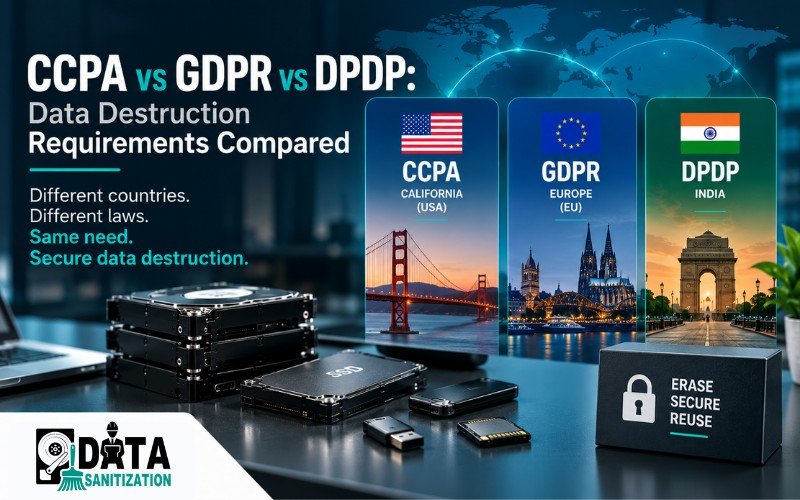
Businesses working across different countries often handle personal data under more than one privacy law.
A company may have customers in California, clients in Europe and employees or customers in India. This makes data privacy compliance more complex, especially when personal information is no longer required.
A common question is:
What happens to personal data when it needs to be deleted and how should the related storage devices be securely sanitized?
The CCPA/CPRA, GDPR and DPDP Act have different requirements, but they share an important practical concern: organizations need to manage personal data throughout its lifecycle.
This includes knowing what data is collected, where it is stored, how long it should be retained, when it can be deleted and what happens to the physical devices containing that information.
This guide explains CCPA vs GDPR vs DPDP from a practical data destruction and data sanitization perspective.
CCPA vs GDPR vs DPDP: Quick Comparison
Area | GDPR | CCPA/CPRA | DPDP Act |
Region | EU/EEA | California, USA | India |
Main focus | Personal data protection | Consumer privacy | Digital personal data |
Deletion | Right to erasure with exceptions | Right to delete with exceptions | Erasure within the DPDP framework |
Retention | Do not retain longer than necessary | Subject to applicable requirements | Subject to applicable requirements |
Sensitive data | Special categories receive stronger protection | Sensitive Personal Information controls | Requirements depend on processing |
IT concern | Secure erasure and lifecycle management | Deletion and downstream controls | Secure deletion and retention controls |
This is a simplified operational comparison. Actual requirements depend on the organization, data, processing activity, jurisdiction, exemptions and retention obligations.
What Is Data Destruction Compliance?
Data destruction compliance means having a controlled process for deleting or sanitizing information when deletion is authorized or required.
There are two important sides.
Logical Data Deletion
This involves removing information from:
- Databases
- Applications
- User accounts
- Cloud platforms
- File systems
- Business software
Physical Media Sanitization
This addresses storage devices such as:
- HDDs
- SSDs
- NVMe drives
- Servers
- SAN/NAS systems
- USB drives
- Memory cards
- Laptops
- Backup media
Deleting a customer record from a database does not automatically sanitize an old SSD or hard drive.
For organizations retiring physical IT assets, our hard drive disposal guide explains the difference between deletion, formatting, sanitization and physical destruction.
GDPR Data Destruction and Right to Erasure
The General Data Protection Regulation (GDPR) provides individuals with a right to erasure in specific circumstances.
For example, personal data may need to be erased when it is no longer necessary for the purpose for which it was collected, subject to applicable exceptions.
GDPR also includes the principle of storage limitation, which means organizations should not keep personal data longer than necessary.
A practical lifecycle is:
Collect → Use → Retain when required → Review → Delete → Securely dispose
For IT teams, this means considering personal data stored on:
- Employee computers
- Company laptops
- Servers
- Backup devices
- SSDs
- HDDs
- Removable media
Professional data sanitization services can support the physical-media side of this lifecycle.
CCPA vs CPRA: Data Deletion Requirements
The California Privacy Rights Act (CPRA) amended and expanded the CCPA. It did not simply replace the CCPA.
California consumers have rights that include the right to delete, subject to applicable exceptions.
Organizations should therefore understand where personal information exists.
It may be stored in:
- Customer databases
- CRM systems
- Employee systems
- Cloud environments
- Backups
- Archived systems
- Third-party services
- Retired IT equipment
This makes CCPA compliance more than a privacy-policy exercise.
Organizations also need practical processes for handling personal information when devices are retired or transferred.
DPDP Act and Data Erasure in India
India’s Digital Personal Data Protection Act, 2023 (DPDP Act) provides a framework for protecting digital personal data.
The DPDP framework uses its own concepts, including Data Principal and Data Fiduciary and should not simply be treated as an Indian version of GDPR.
For organizations operating in India, data deletion should be connected to:
Data identification → Retention review → Authorized deletion → Secure erasure → Verification → Documentation
Organizations should also consider applicable legal, contractual and business retention requirements before permanently deleting information.
This makes DPDP compliance relevant to both privacy teams and IT teams managing company devices and storage infrastructure.
GDPR vs CCPA vs DPDP: What Is the Same?
Although the laws are different organizations can build common operational controls around them.
A strong data privacy programme should include:
- Data inventory – Know where personal information exists.
- Retention controls – Know what information must be retained.
- Deletion procedures – Define when data can be deleted.
- Media sanitization – Secure physical storage when required.
- Verification – Confirm the sanitization process.
- Documentation – Maintain appropriate records.
- Final disposition – Control reuse, resale, recycling or destruction.
The legal requirements are different, but these operational controls can provide a common foundation.
Why NIST SP 800-88 Matters
NIST SP 800-88 provides technical guidance for media sanitization.
The current SP 800-88 Rev. 2 focuses on establishing a media-sanitization programme and selecting appropriate techniques based on factors such as information sensitivity and media characteristics.
The important point is that NIST is technical guidance, not a privacy law.
Organizations can use media-sanitization guidance as part of their technical data destruction programme while separately addressing GDPR, CCPA/CPRA, DPDP and other legal requirements.
Read our NIST 800-88 data destruction standards guide for more information.
HDD vs SSD Data Destruction
Not every storage device should be sanitized in exactly the same way.
HDD Data Sanitization
Traditional magnetic hard drives can be sanitized when they are suitable for reuse or physically destroyed when permanent disposal is required.
Our HDD data sanitization services support organizations handling retired hard drives.
SSD and NVMe Data Sanitization
SSDs and NVMe devices use flash-based storage and controller technologies. Therefore organizations should select an appropriate sanitization method for the specific media.
Our SSD data sanitization services provide dedicated support for solid-state storage.
How Data Sanitization Pro Helps With Enterprise Data Erasure
For organizations managing large numbers of storage devices, manual wiping can become difficult to control and document.
Data Sanitization Pro is a Made in India data sanitization software platform designed for secure, verifiable and standards-based data erasure. It supports HDD, SSD, NVMe, USB, memory cards, RAID, SAN, NAS, enterprise storage and other supported media.
The platform supports 20+ sanitization methodologies, including NIST 800-88 Clear, NIST 800-88 Purge, DoD 5220.22-M, HMG IS5, Secure Erase, Enhanced Secure Erase, Gutmann and custom organizational policies.
It also provides:
- Multi-device sanitization
- Post-sanitization verification
- Hash verification
- Integrity validation
- Real-time progress monitoring
- Hex-level analysis
- SMART storage health monitoring
- Bad-sector reporting
- Hardware assessment
- PDF and HTML audit reports
- Online and offline deployment
- Air-gapped environment support
These features can help IT teams and ITAD providers create a more structured data wiping and verification workflow.
Explore Data Sanitization Pro:
www.datasanitizationpro.com
Can One Data Destruction Process Support GDPR, CCPA and DPDP?
Yes, from an operational perspective organizations can create a common global data destruction process.
But one technical process does not automatically make an organization legally compliant with all three laws.
A practical framework can be:
Identify → Retain when required → Authorize deletion → Sanitize → Verify → Report → Dispose
Then add jurisdiction-specific requirements for:
- GDPR compliance
- CCPA compliance
- DPDP compliance
- Sector regulations
- Contracts
- Legal retention
- Internal security policies
This approach can make data destruction compliance easier to manage across multiple locations.
Common Data Destruction Compliance Mistakes
1. Treating File Deletion as Secure Erasure
Deleting a file does not automatically sanitize physical media.
2. Forgetting Backups
Backup systems may contain older copies of personal information.
3. Ignoring Third-Party Processors
Organizations should understand how relevant service providers handle deletion requirements.
4. Using the Same Method for Every Storage Device
HDDs, SSDs and other media can require different approaches.
5. Destroying Data Without Checking Retention
Information should not be permanently destroyed before applicable retention requirements are reviewed.
6. Sending Devices Directly for Recycling
Recycling a device does not automatically mean its data has been securely erased.
7. Keeping No Evidence
Asset records, sanitization results and audit reports can help demonstrate that the process was controlled.
Data Destruction Compliance Checklist
Before retiring an IT asset, ask:
- Is the data still required?
- Has deletion been authorized?
- Have backups and copies been identified?
- Have third-party systems been considered?
- What type of storage is being processed?
- Is the sanitization method appropriate?
- Has the process been verified?
- Is the asset tracked?
- Has a report been generated?
- Has final disposition been recorded?
Conclusion
CCPA vs GDPR vs DPDP is not simply a comparison of three privacy laws.
For IT and security teams, the bigger challenge is turning privacy requirements into a practical data lifecycle.
Organizations need to know:
What data exists → Where it exists → How long it should be retained → When it can be deleted → How physical media should be sanitized → How the result should be verified and documented
GDPR provides a right to erasure in specific circumstances. CCPA/CPRA provides important California consumer rights, including deletion. India’s DPDP Act establishes its own framework for digital personal data.
A common operational programme can support all three while keeping their legal differences in mind.
For professional physical media sanitization, Data Sanitization provides secure data destruction services for HDDs, SSDs, servers, flash media and other IT assets.
For organizations looking for software to manage secure data erasure, verification, multi-device sanitization and audit reporting, Data Sanitization Pro provides a Made in India platform built for enterprise, government, ITAD and other professional environments.
Data Sanitization Pro
Secure. Verify. Report.
www.datasanitizationpro.com
Data Sanitization
New Delhi, India
Phone: +91-852-770-9690
Email: support@datasanitization.in
Disclaimer: This article is for general educational purposes and is not legal advice. GDPR, CCPA/CPRA and DPDP requirements depend on the organization, jurisdiction, data processing activities, exemptions, contracts and applicable retention requirements. Organizations should obtain appropriate legal or compliance advice for their specific situation.
Related Data Destruction Guides
If you are building a complete data destruction programme, these guides may also help:
Frequently Asked Questions
1. What is the best way to securely destroy data?
Businesses can use Data Sanitization Pro to securely erase data from drives and devices using software-based data sanitization.
2. Can data be destroyed remotely?
Yes. Data Sanitization Pro supports remote data erasure, helping businesses securely wipe data without physical access to the device.
3. Is data sanitization software secure?
Yes. Data Sanitization Pro securely sanitizes storage media using recognized data-erasure methods and provides reporting for verification.
4. Is hard drive shredding better than data sanitization?
Both methods have different purposes. Data Sanitization Pro can sanitize drives for reuse, while shredding physically destroys the storage media.
5. How can businesses securely dispose of old devices?
Businesses can use Data Sanitization Pro for software-based or remote data erasure before reuse or disposal, depending on their requirements.
Need Onsite Data Sanitization Services?
Do you want Data Sanitization Services to be provided at your location? No worries!! We got it covered. Our team members will be appointed to finish the job at your location after you book the appointment with us. Please feel free to contact us.