

Banks and NBFCs handle some of the most sensitive information in India.
Customer KYC records, account details, loan documents, transaction histories, credit information, employee records, financial statements, card information and internal banking data can exist across laptops, desktops, servers, hard drives, SSDs, backup systems and other IT assets.
The security risk does not end when a device is switched off.
A retired server can still contain customer information. An old laptop returned after an employee leaves can still hold downloaded documents. A replaced hard drive can contain years of business records. Even equipment sent to a recycler can become a data security risk if the information stored on it has not been securely removed.

This makes financial data destruction an important part of the information lifecycle for banks, NBFCs and other RBI-regulated entities.
The issue is becoming even more important as financial institutions increasingly rely on technology vendors, cloud providers and other third parties. In July 2026, RBI proposed stronger data-governance expectations around third-party data sharing, including need-to-know access, controls against unauthorised reuse or duplication, and continued accountability by regulated entities.
In simple terms, outsourcing a process does not mean outsourcing responsibility for protecting the data.
Why Data Destruction Matters for Banks and NBFCs
A bank may replace thousands of computers every year. Branches may upgrade systems, data centres may retire servers, ATMs may be replaced, and storage devices may be removed during infrastructure upgrades.
Every one of these activities creates a data disposal point.
The challenge is that ordinary deletion is not the same as secure data destruction.
Deleting a file generally removes its reference from the file system. Formatting a drive also does not automatically provide assurance that sensitive information cannot be recovered. For financial institutions, the objective should be to use an appropriate sanitization or destruction method based on the storage technology, security requirements and intended disposition of the asset.
A secure lifecycle should therefore look like:
Identify → Classify → Retain where required → Sanitize → Verify → Document → Reuse or Destroy
This approach connects information security with IT asset management instead of treating disposal as the final, informal step.
What Is Data Destruction in Banking?

Data destruction is the controlled process of making information permanently inaccessible so that it cannot be reasonably recovered from the storage media.
For banks and NBFCs, this can involve:
- Hard drive data destruction
- SSD data sanitization
- Server data destruction
- Laptop and desktop data erasure
- ATM storage sanitization
- Backup media destruction
- USB and removable media wiping
- SAN and NAS storage sanitization
- Data centre asset retirement
- Secure IT asset disposal
- Physical destruction of storage media where required
The important point is that the method should match the technology.
An HDD, SSD, magnetic tape and other storage technologies do not necessarily require the same sanitization technique.
What Does RBI Require From Banks and NBFCs?
There is an important distinction here.
RBI does not simply publish one standalone rule saying, “Banks must use a particular hard-drive wiping software.” Instead, RBI’s regulatory framework places strong responsibilities on regulated entities around confidentiality, security, outsourcing risk, control over service providers, records and safe removal or destruction of data and hardware.
RBI’s Master Direction on Outsourcing of Information Technology Services, 2023 applies to a broad range of regulated entities, including scheduled commercial banks, small finance banks, payments banks, primary urban cooperative banks, NBFCs, credit information companies and specified all-India financial institutions.
The direction is particularly relevant when data destruction is outsourced.
RBI requires regulated entities to maintain responsibility for customer data and information handled by service providers. It also requires appropriate risk management, documented assessments and controls around outsourced activities.
Most importantly for IT retirement, RBI’s outsourcing framework says that exit strategies should include necessary contractual provisions for the safe removal or destruction of data, hardware and records, whether digital or physical, where applicable.
That makes secure data destruction more than a simple IT housekeeping task. It can form part of the bank’s broader outsourcing, information security, asset retirement and risk-management framework.
What RBI Expectations Mean for an Outsourced Data Destruction Vendor

If a bank or NBFC sends old storage devices to a third-party provider, it should not simply hand over the equipment and assume the job is finished.
The regulated entity should assess the provider and define controls around the service.
Important areas include:
1. Confidentiality
Customer information must remain protected throughout collection, transportation, storage and destruction.
2. Access Control
People handling devices should receive only the access required to perform their assigned work.
3. Asset Identification
Each device should be identifiable so the institution knows what was submitted and what happened to it.
4. Audit Rights
Contracts should support appropriate audit, monitoring and access requirements.
5. Subcontractor Control
The bank should know whether another company will handle the devices or data.
6. Secure Destruction
The agreement should clearly define how data, hardware and records will be removed or destroyed.
7. Evidence
The institution should receive appropriate records demonstrating what was processed and what action was completed.
These principles are consistent with RBI’s wider outsourcing approach, which requires regulated entities to retain oversight and protect customer information even when services are performed by external providers.
How Does the DPDP Act Affect Data Destruction?

The Digital Personal Data Protection Act, 2023 (DPDP Act) adds another important layer to the discussion.
The Act requires a Data Fiduciary to implement appropriate technical and organisational measures and take reasonable security safeguards to prevent personal data breaches. It also provides for erasure of personal data when the specified purpose is no longer being served, unless retention is necessary to comply with another law.
This last point is especially important for banks.
A bank cannot simply delete every customer record immediately because the customer has closed an account. If another applicable law requires the bank to retain particular records for a defined period, that legal retention requirement takes priority.
So the correct approach is:
Retention requirement first → Secure storage during retention → Secure erasure after the lawful retention period
This is why data destruction should be connected to the organization’s data retention policy, not treated as an independent activity.
RBI and DPDP Act: What Banks Should Understand
RBI requirements and the DPDP framework should not be treated as two completely separate checklists.
They address different aspects of information governance, but they can overlap significantly for customer data.
Area | RBI Perspective | DPDP Perspective |
Customer information | Confidentiality and security are important responsibilities | Personal data must be protected |
Third parties | Regulated entities retain oversight of outsourcing risks | Data processing must be governed appropriately |
Security | Risk management and security controls | Reasonable security safeguards |
Retention | Records may need to be preserved according to applicable requirements | Erasure when the purpose is no longer served, unless retention is legally required |
Disposal | Safe removal/destruction provisions should be addressed where applicable | Personal data should be erased when applicable |
Accountability | RBI-regulated entity remains responsible for outsourced activities | Data Fiduciary has statutory responsibilities |
The DPDP Rules, 2025 were notified in November 2025, but their provisions have a phased commencement schedule. As of August 2026, organisations should therefore distinguish between provisions already in force and those scheduled for later commencement rather than describing the entire framework as immediately applicable. The notified Rules place major substantive requirements, including security safeguards, breach-related requirements and retention-related provisions, in the later implementation phase beginning May 2027.
This distinction is important for accurate compliance communication.
What Data and Devices Need Secure Destruction?
A bank’s data environment is much larger than office computers.
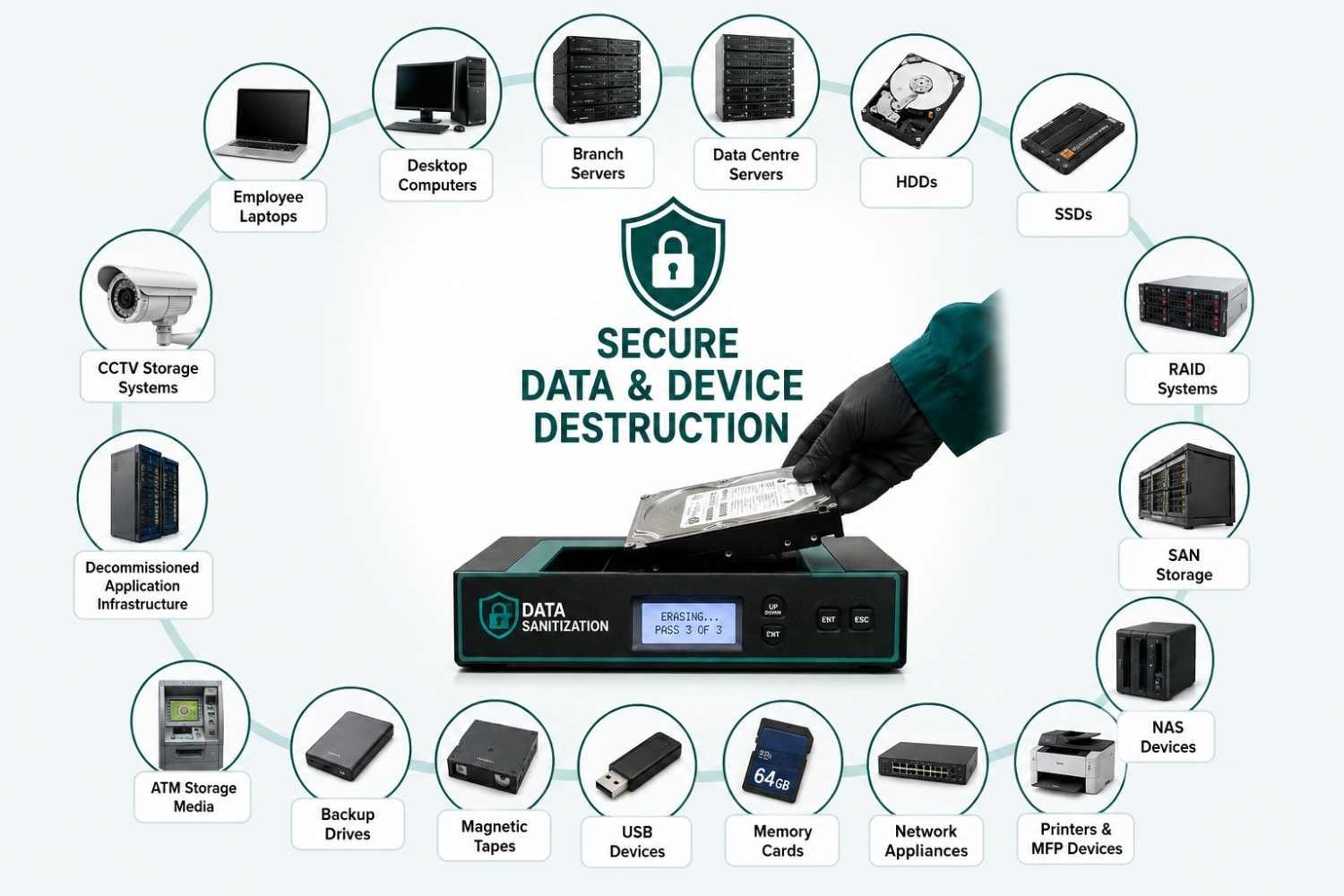
A practical banking data destruction programme may cover:
- Employee laptops
- Desktop computers
- Branch servers
- Data centre servers
- HDDs
- SSDs
- RAID systems
- SAN storage
- NAS devices
- ATM storage media
- Backup drives
- Magnetic tapes
- USB devices
- Memory cards
- Network appliances
- Printers and multifunction devices containing storage
- CCTV storage systems
- Decommissioned application infrastructure
The institution should maintain an inventory so that storage-containing equipment is not accidentally sent for recycling before data sanitization.
Which Data Destruction Method Should Banks Use?
There is no universal method for every device.
Secure Data Wiping
Software-based sanitization can be appropriate when the organization wants to remove data while keeping the device usable.
This is useful for:
- Laptop redeployment
- Desktop reuse
- Server resale
- IT asset recovery
- Lease returns
Cryptographic Erasure
Where encryption and the storage architecture support it, cryptographic techniques can be part of the sanitization strategy.
Degaussing
Degaussing uses a strong magnetic field and is intended for appropriate magnetic media. It is not a universal solution for modern SSDs.
Physical Destruction
Physical destruction may be appropriate when a storage device must not be reused or when the media condition or security policy requires destruction.
The method should be selected according to the media type, security classification, reuse requirement and applicable policy.
What Should a Secure Banking Data Destruction Process Look Like?

A mature process should include the following stages:
Step 1: Identify the Asset
Record the asset ID, serial number, device type and ownership.
Step 2: Classify the Data
Determine what type of information may be present and whether retention obligations apply.
Step 3: Confirm Retention
Do not destroy records simply because hardware is being retired. Confirm that required records have been retained appropriately.
Step 4: Select the Sanitization Method
Choose an appropriate method for HDDs, SSDs, tapes or other media.
Step 5: Perform Sanitization or Destruction
Use a controlled process with restricted access.
Step 6: Verify
Do not rely only on a statement that “the drive was wiped.” Verification provides stronger assurance.
Step 7: Generate Documentation
Maintain records linking the asset to the completed destruction or sanitization activity.
Step 8: Reuse or Recycle
After successful sanitization, suitable equipment can be redeployed or processed for responsible recycling.
What Is an ITAD Solution for Banks?
IT Asset Disposition (ITAD) is the structured process of managing technology assets when they reach the end of their operational life.
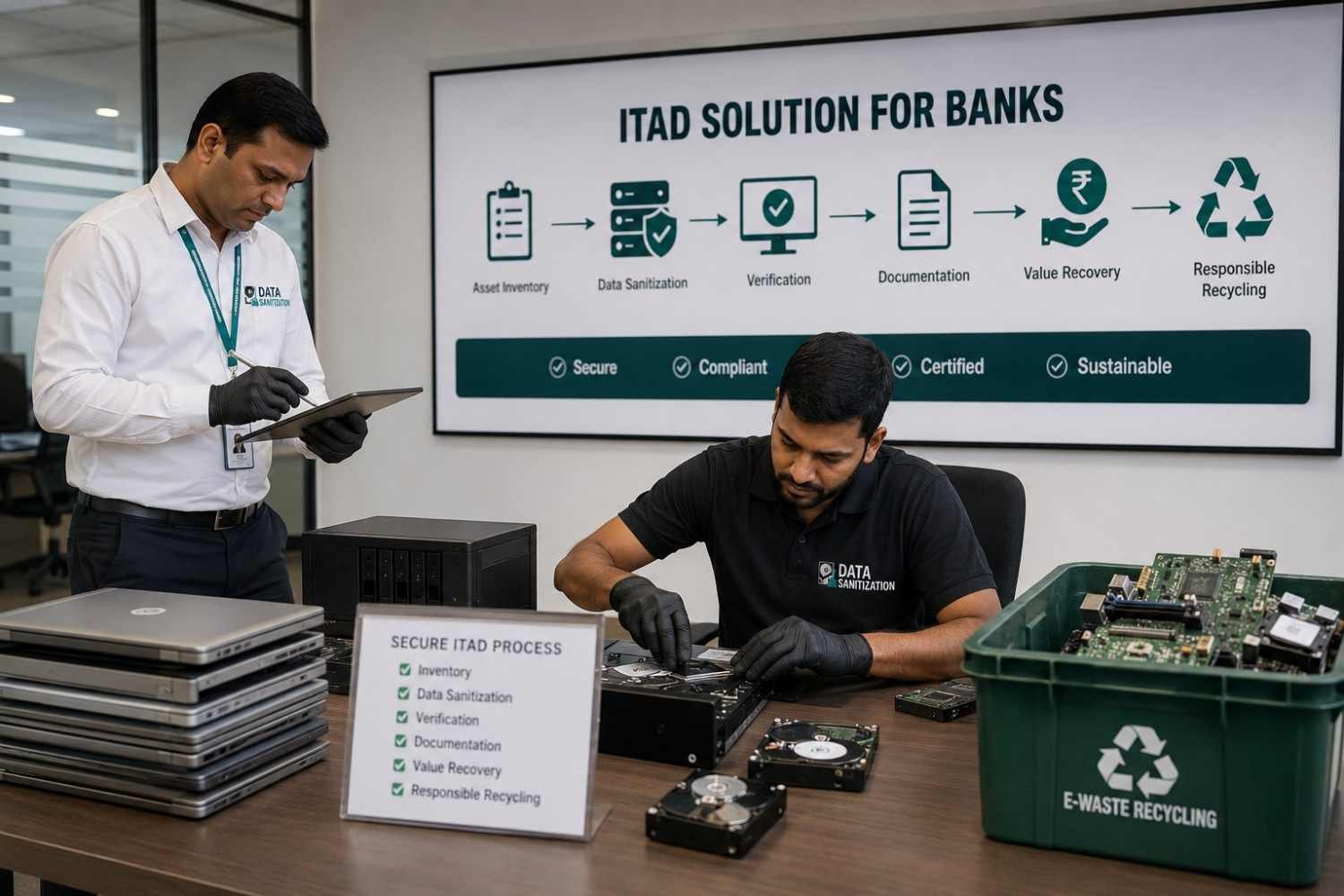
For banks and NBFCs, ITAD should not be viewed simply as selling old computers.
A secure banking ITAD solution should connect:
Asset Inventory + Data Sanitization + Verification + Documentation + Value Recovery + Responsible Recycling
This approach can help financial institutions manage large-scale technology refreshes while reducing the risk that sensitive information leaves their control.
For example, when a bank replaces 2,000 branch computers, the project should not end when the old computers reach a recycler. The bank needs evidence showing which assets were processed, what sanitization method was used and what happened to each asset afterwards.
ALSO READ: What is ITAD? Complete Guide to IT Asset Disposition Services
What Documentation Should Banks Receive?
Documentation is one of the biggest differences between informal disposal and professional data destruction.
Depending on the process, a bank may require:
- Asset-wise sanitization records
- Device serial numbers
- Date and time of processing
- Sanitization method
- Verification status
- Operator or process identification
- Certificate of data destruction
- Chain-of-custody records
- Collection records
- Final disposition information
- Recycling documentation where applicable
A certificate alone should not be treated as proof that a process was technically successful.
Good documentation should connect the specific asset with the specific sanitization or destruction event.
Common Data Destruction Mistakes in Banks and NBFCs
Some of the most common mistakes include:
- Deleting files instead of sanitizing the entire storage media
- Treating formatting as permanent data destruction
- Using the same method for HDDs and SSDs
- Sending devices to recyclers before sanitization
- Failing to track serial numbers
- Ignoring third-party and subcontractor risks
- Destroying records before their legal retention period ends
- Keeping no evidence of successful sanitization
- Allowing uncontrolled transportation of retired devices
- Treating data destruction as a procurement task instead of a security process
These gaps can create unnecessary exposure at the very point where an organization believes the data is already “gone.”
Banking Data Destruction Checklist
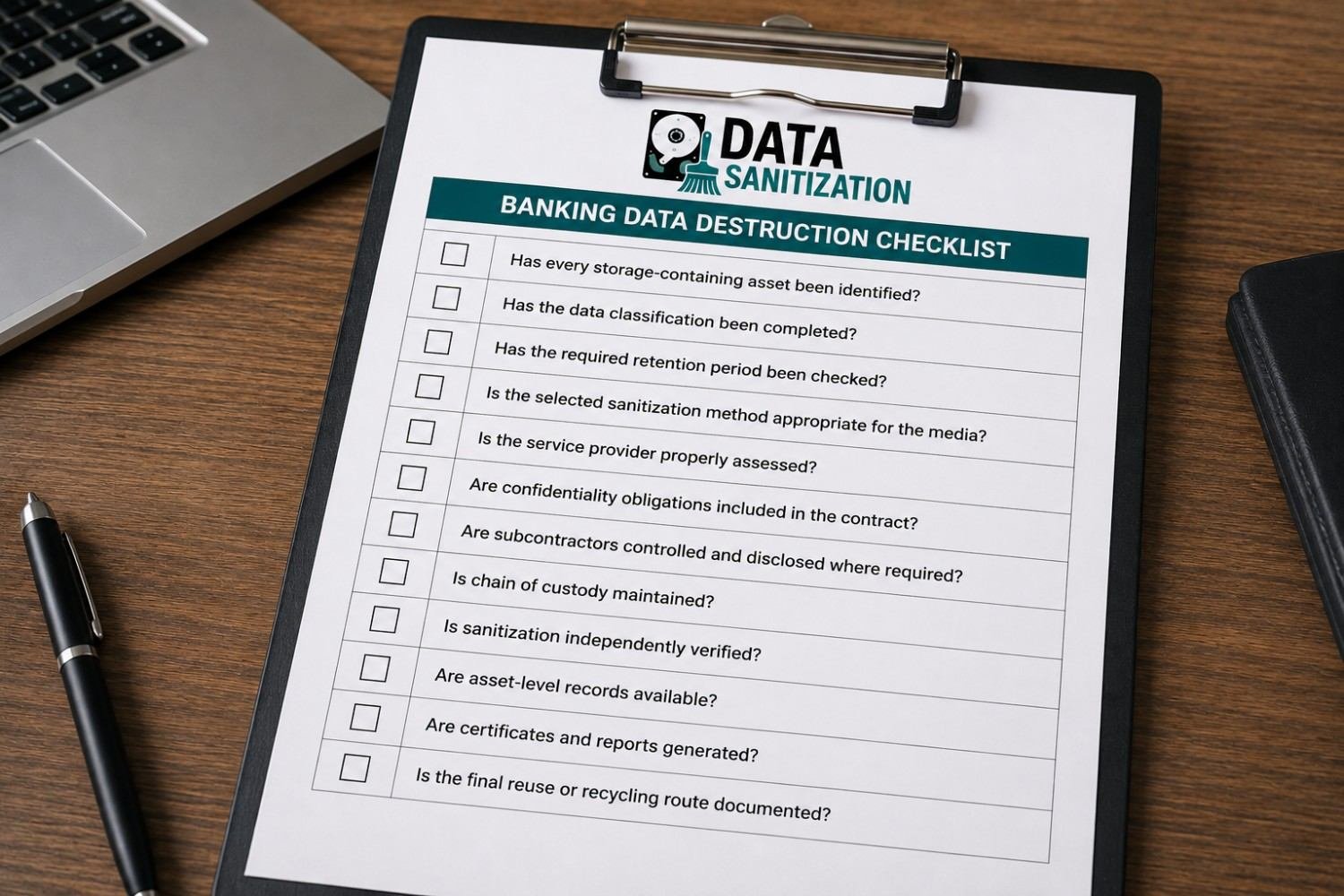
Before approving a data destruction project, banks and NBFCs should ask:
- Has every storage-containing asset been identified?
- Has the data classification been completed?
- Has the required retention period been checked?
- Is the selected sanitization method appropriate for the media?
- Is the service provider properly assessed?
- Are confidentiality obligations included in the contract?
- Are subcontractors controlled and disclosed where required?
- Is chain of custody maintained?
- Is sanitization independently verified?
- Are asset-level records available?
- Are certificates and reports generated?
- Is the final reuse or recycling route documented?
Why Certified Data Destruction Matters
For financial institutions, the goal should not simply be to make a storage device look empty.
The real objective is to create a controlled, repeatable and auditable process that protects customer information throughout the asset lifecycle.
A professional banking data destruction service can help institutions manage this process across branches, offices, data centres and other locations.
Data Sanitization provides secure data erasure and destruction solutions for organizations handling sensitive information, including HDDs, SSDs, servers, laptops, desktops, storage systems and other digital media.
The focus is on controlled handling, appropriate sanitization methods, verification and documentation rather than simply collecting old equipment.
Conclusion
For banks and NBFCs, data destruction is no longer something that should happen quietly at the end of an IT asset’s life.
Financial institutions operate with large volumes of customer and business information, while increasingly depending on technology vendors and external service providers. RBI’s outsourcing framework makes it clear that regulated entities retain responsibility for managing these risks, protecting customer information and maintaining appropriate control over outsourced activities.
At the same time, India’s DPDP framework is creating a stronger focus on responsible personal data handling, security safeguards and appropriate erasure when information is no longer required, subject to applicable legal retention requirements.
For this reason, financial data destruction should be treated as part of the complete data lifecycle—not simply as an e-waste activity.
A strong programme combines asset tracking, retention controls, secure sanitization, verification, chain of custody, documentation and responsible final disposition.
For banks, NBFCs and other financial institutions planning hardware refreshes, branch closures, server retirement or large-scale IT asset disposal, a properly controlled data destruction process can provide an important layer of protection for customer information and organizational trust.
Data Sanitization supports organizations with secure data erasure, media sanitization and data destruction solutions for HDDs, SSDs, servers, laptops, desktops and enterprise storage devices.
Website: www.datasanitization.in
Email: support@datasanitization.in
Phone: +91-852-770-9690
Disclaimer: This article is for general informational purposes only and does not constitute legal or compliance advice. Banks and NBFCs should review their applicable RBI requirements, data-retention obligations, contractual requirements, and current DPDP Act implementation status with their legal or compliance teams.