
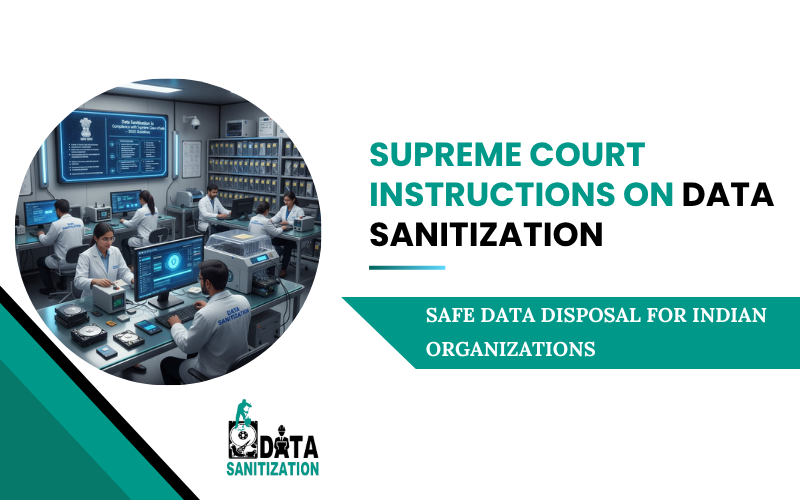
In the digital age, data is an invaluable asset — but with it comes a critical responsibility to protect sensitive information from unauthorized access, breaches, and misuse. The Supreme Court of India has reinforced this responsibility through clear instructions and guidelines on data sanitization and safe data disposal. Indian organizations must adopt certified, secure data erasure methods to comply with legal mandates and uphold the fundamental right to privacy.

This comprehensive blog dives deep into the Supreme Court’s directives, explores the significance of secure data sanitization, and outlines how Indian enterprises can ensure full compliance in 2025 and beyond.
⚖️ Why Data Sanitization is Critical: Insights from the Supreme Court
The Supreme Court’s landmark verdict on the Right to Privacy (Justice K.S. Puttaswamy vs Union of India, 2017) recognized privacy as a constitutional right, making it imperative for businesses and government bodies to safeguard personal data rigorously.
To honor these privacy rights, organizations must:
🗸 Implement permanent, irreversible data sanitization procedures that leave no trace of sensitive information.
🗸 Follow robust protocols for safe data disposal of physical and electronic media, including HDDs, SSDs, mobile devices, RAID systems, pen drives, memory cards, and IoT devices.
🗸 Prevent data recovery attempts that could lead to breaches or misuse.
📝 Supreme Court’s Key Instructions on Data Sanitization & Safe Disposal

1. Mandated Complete Data Erasure
The court directs that data sanitization must be thorough and effective, using industry-accepted techniques such as multi-pass overwriting, degaussing, or physical destruction to eliminate all traces of data.
2. Comprehensive Data Lifecycle Policies
Organizations are expected to maintain strict governance over data collection, storage, usage, and destruction to ensure compliance with privacy laws and court guidelines.
3. Certified and Documented Sanitization
Data erasure must be certified with detailed documentation to facilitate audits, transparency, and accountability, particularly for sensitive government and corporate data.
4. Prevention of Data Recovery
Sanitization methods must ensure that data cannot be retrieved by forensic tools or cybercriminals, safeguarding against identity theft, fraud, and corporate espionage.
5. Alignment with Data Privacy Legislation
These instructions complement India’s IT Act, the upcoming Personal Data Protection Bill, and international standards such as GDPR, reinforcing the necessity of secure data erasure.
The Constitutional Shift: How Judicial Precedent Mandates a Verifiable Audit Trail
With the Supreme Court of India firmly establishing the Right to Privacy as a fundamental right under Article 21 of the Constitution, data lifecycle management has evolved from a routine IT task into a critical legal obligation. The judiciary’s stance is clear: when an individual hands over personal data to a corporation, that organization acts as a custodian. Consequently, when the purpose for collecting that data is fulfilled, the custodian is under a strict constitutional mandate to ensure that the data is not just removed, but completely eradicated from existence.
The Failure of “Standard Deletion” Under Judicial Scrutiny
From a legal compliance standpoint, standard operating system deletion or manual disk formatting fails the judicial standard for safe asset disposal. The Supreme Court’s guidelines emphasize that destruction must be absolute and permanent. Because forensic tools can effortlessly reconstruct files from formatted hard drives or un-sanitized Solid-State Drives (SSDs), relying on basic software methods introduces an immediate executive liability. If a retired corporate server or employee laptop is discovered in a local electronic waste market with active data fragments intact, the organization cannot legally claim it took “reasonable security steps.”
Building a Defensible Legal Armor
To align your enterprise disposal policies with judicial expectations and the statutory mandates of the DPDP Act, your IT asset disposition workflow must incorporate a non-negotiable step: automated verification.
True compliance requires transitioning to firmware-level NIST 800-88 Rev. 1 purges that wipe every hidden, over-provisioned sector of storage media. More importantly, this process must generate an immutable, serialized Certificate of Destruction. In a court of law or a regulatory audit, this certificate serves as your ironclad defense, providing the definitive, auditable proof that your organization respected the constitutional right to erasure.
🛠️ Common Data Sanitization Techniques Following Supreme Court Guidelines

- Overwriting: Multiple passes of random or fixed pattern data overwrite the original information to make recovery impossible.
- Degaussing: Magnetic disruption for HDDs to obliterate data physically.
- Physical Destruction: Shredding, crushing, or incinerating storage media to ensure permanent data loss.
🔥 Handling Damage Media and Complex Storage Types
In addition to typical storage media, organizations face challenges with damaged or complex devices, including:
🔹 Physical damage, fire, water, or flood damage
🔹 Boot loop errors on Android and iPhone devices
🔹 Firmware corruption and weak heads on drives
🔹 Complex storage like RAID arrays, mobile devices, drones, IoT devices, CCTV footage
🔹 Chip-off, JTAG, ISP techniques for forensic recovery
🔹 Imaging challenges for secure erasure and recovery verification
Supreme Court guidelines imply that organizations must tailor sanitization strategies to address these scenarios effectively.
🤝 Partnering for Complete Data Security: Data Sanitization & Data Engineers

At Data Sanitization, we provide certified, comprehensive data erasure services across all types of storage media, ensuring compliance with Supreme Court mandates and India’s evolving privacy landscape.
But how can organizations be absolutely sure that sanitized data can never be recovered, even by the most sophisticated forensic techniques?
This is where our sister concern, Data Engineers, India’s leading data recovery and digital forensic experts, play a crucial role. Data Engineers specializes in professional recovery from severely damaged, corrupted, or complex devices and conducts forensic investigations that push the boundaries of data retrieval.
Together, we offer a full-circle assurance: after Data Sanitization’s secure erasure, Data Engineers rigorously tests the media to confirm that no data remnants are recoverable. This collaboration ensures your organization’s data disposal is genuinely secure, protecting privacy and meeting Supreme Court and regulatory expectations.
⚠️✅Why Indian Organizations Must Prioritize Certified Data Sanitization
Ignoring Supreme Court instructions on data sanitization can lead to:

❗ Legal repercussions under India’s data protection laws
❗ Severe financial penalties and operational risks
❗ Loss of stakeholder trust and reputational harm
Certified data sanitization safeguards sensitive data, upholds legal compliance, and fortifies organizational integrity against cyber threats.
🛡️📜 Conclusion
The Supreme Court’s clear instructions on data sanitization and safe data disposal are a vital pillar of India’s data privacy and security framework. Indian organizations must adopt certified, irreversible data erasure practices and partner with expert providers like Data Sanitization for secure disposal solutions.
For comprehensive support covering data sanitization, forensic validation, and expert data recovery, trust the proven partnership of Data Sanitization and Data Engineers — leaders in India’s data security ecosystem.
Protect your organization. Comply with the law. Secure your data.