
Every business stores valuable information on digital storage devices. Financial records, employee details, customer databases, legal documents and confidential business files often remain stored on hard drives even after files are deleted or devices are retired.
Simply formatting a hard drive or deleting files does not permanently remove the data. In many cases, the information can still be recovered using specialized recovery tools.
This is why organizations rely on professional Data Destruction and Media Sanitization methods when retiring storage devices.
One of the most effective techniques for destroying data stored on magnetic media is degaussing.
In this guide, you’ll learn the degaussing meaning, how it works, which storage devices it supports, its advantages and limitations and how it compares with other data destruction methods such as secure data wiping and physical destruction.
What is Degaussing?
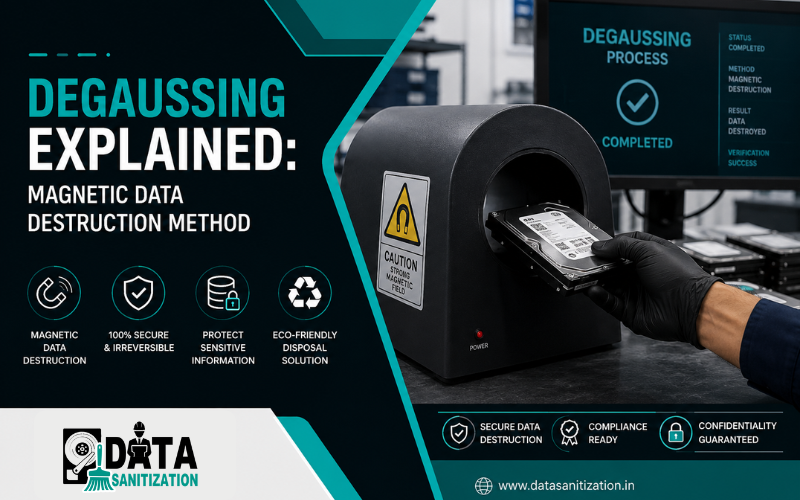
Degaussing is a magnetic data destruction method that permanently erases information stored on magnetic storage devices by exposing them to an extremely powerful magnetic field.
The strong magnetic field disrupts the magnetic patterns that store digital information, making the original data unreadable.
Unlike deleting files or formatting a drive, degaussing removes the magnetic signatures that represent stored information, making data recovery virtually impossible on compatible media.
Because of its effectiveness, degaussing is widely used by organizations that handle confidential information and require secure media sanitization before disposing of retired storage devices.
Degaussing Meaning
The word degaussing originally referred to the process of removing or reducing unwanted magnetic fields from equipment.
In information security, the degaussing meaning is different. It refers to permanently destroying data stored on magnetic media using a specialized machine called a degausser.
A professional degausser generates an intense magnetic field that completely randomizes the magnetic domains inside a storage device.
Once this process is complete, the original data cannot be reconstructed because the magnetic structure used to store information no longer exists.
What Magnetic Data Storage Works
To understand why degaussing is effective, it helps to understand how magnetic storage devices work.
Traditional hard disk drives (HDDs) store information by organizing billions of tiny magnetic particles on rotating platters.
Each magnetic particle represents binary information that forms files, operating systems, databases and application data.
Whenever a file is created, modified or deleted, the magnetic orientation changes.
A degausser generates an extremely powerful magnetic field that completely disrupts these magnetic patterns, permanently destroying the stored information.
This process affects the entire storage surface instead of individual files, ensuring comprehensive data destruction.
How Degaussing Works
A professional degaussing process follows several important steps to ensure secure media sanitization.
Step 1 – Device Identification
The storage device is first inspected to confirm that it contains magnetic media suitable for degaussing.
Examples include:
- Hard Disk Drives (HDDs)
- Magnetic backup tapes
- LTO tapes
- DLT tapes
- DAT tapes
Solid State Drives (SSDs) cannot be degaussed because they do not use magnetic storage.
Step 2 – Secure Asset Handling
The storage media is documented and tracked before processing.
Organizations often maintain:
- Asset inventory
- Device serial numbers
- Chain of custody records
- Internal approval documentation
These records help ensure every storage device is accounted for throughout the destruction process.
Step 3 – Magnetic Data Destruction
The storage device is placed inside a certified degausser.
The machine generates an extremely powerful magnetic field that removes the magnetic patterns storing digital information.
Once complete, the stored data is permanently destroyed.
Step 4 – Verification
After degaussing organizations verify that the process has been completed according to internal security procedures.
Many businesses also document:
- Date of destruction
- Device identification
- Operator details
- Project information
This documentation supports audits and compliance requirements.
Which Devices Can Be Degaussed?
Degaussing is designed specifically for magnetic storage media.
Common examples include:
- Hard Disk Drives (HDDs)
- Enterprise HDDs
- Magnetic backup tapes
- LTO tapes
- DLT tapes
- DAT tapes
- Magnetic archive media
These devices store information using magnetic fields, making them suitable for degaussing.
Can SSDs Be Degaussed?
One of the biggest misconceptions about degaussing is that it works on every storage device.
The answer is No.
Solid State Drives (SSDs) use flash memory chips instead of magnetic storage.
Since SSDs contain no magnetic components, a degausser has no effect on the stored information.
For SSDs organizations should use approved data sanitization methods such as certified secure erase or physical destruction when required.
Benefits of Degaussing
Professional degaussing offers several important advantages for organizations that need secure data destruction.
Permanently Destroys Magnetic Data
The magnetic patterns storing digital information are completely disrupted, preventing future recovery.
Fast Processing
Large volumes of magnetic media can often be processed quickly, making degaussing suitable for enterprise projects.
Supports Media Sanitization
Degaussing forms an important part of professional media sanitization strategies for organizations handling confidential information.
Improves Information Security
Proper degaussing helps reduce the risk of unauthorized access to sensitive business, financial, legal, healthcare and government data.
Useful for Large Organizations
Banks, hospitals, government departments, educational institutions, IT companies and data centers frequently retire large numbers of magnetic storage devices.
Professional degaussing provides an efficient solution for securely destroying data before disposal.
Limitations of Degaussing
Although degaussing is highly effective for magnetic media, it is not suitable for every storage device.
Some important limitations include:
- Does not work on SSDs
- Cannot erase USB flash drives
- Ineffective for memory cards
- Does not sanitize smartphones
- Not suitable for flash-based storage
- Requires specialized equipment
- Some degaussed hard drives cannot be reused because the magnetic process may affect the drive’s firmware and servo information.
Understanding these limitations helps organizations choose the most appropriate data destruction method for each type of storage device.
Degaussing vs Data Wiping
Many organizations confuse degaussing with data wiping, but they are two very different data destruction methods. Choosing the right method depends on the type of storage media, security requirements and whether the device will be reused.
Degaussing | Data Wiping |
Uses a powerful magnetic field to erase data | Uses certified software to overwrite existing data |
Designed for magnetic storage media | Works on HDDs, SSDs and many other storage devices |
Data cannot be recovered | Data is securely overwritten following approved methods |
Usually renders magnetic drives unusable | Devices can often be reused after wiping |
Best for high-security environments | Best when devices are being redeployed or resold |
If your goal is to reuse laptops, desktops or servers, certified data wiping is often the better option. If the storage media must never be reused and the highest level of protection is required, degaussing may be appropriate for compatible magnetic media.
Degaussing vs Hard Drive Shredding
Both methods permanently destroy stored information, but they achieve this in different ways.
Degaussing | Hard Drive Shredding |
Destroys magnetic data using a magnetic field | Physically destroys the storage device |
No visible damage to the drive exterior | Device is broken into small pieces |
Suitable only for magnetic media | Suitable for HDDs, SSDs, USB drives and other storage devices |
Requires a degausser | Requires industrial shredding equipment |
Some organizations use both methods for highly sensitive information, especially when internal security policies require multiple layers of protection.
Degaussing vs Physical Destruction
Physical destruction refers to damaging a storage device so it can no longer function.
Examples include:
- Industrial shredding
- Crushing
- Disintegration
- Drilling (not recommended as a standalone enterprise method)
- Media destruction equipment
Unlike degaussing, physical destruction can be applied to many different storage devices, including:
- Hard drives
- SSDs
- USB flash drives
- Memory cards
- Mobile storage devices
The appropriate method depends on the media type, compliance requirements and whether the organization intends to reuse the device.
Media Sanitization Standards
Professional Media Sanitization should follow documented procedures that help organizations securely remove sensitive information before disposal or reuse.
One of the most widely recognized references is NIST SP 800-88, which provides guidance on selecting appropriate media sanitization methods based on the type of storage device and organizational risk.
Depending on the media and business requirements, a media sanitization program may include:
- Certified data wiping
- Secure erase procedures
- Degaussing (for compatible magnetic media)
- Physical destruction
- Verification of completed sanitization
- Audit-ready records
- Certificate of Data Destruction
Following established procedures helps organizations strengthen information security and support internal governance and compliance objectives.
When Should Businesses Use Degaussing?
Degaussing is most suitable when organizations need to permanently destroy data stored on magnetic media and reuse of the storage device is not required.
Typical use cases include:
- Retiring enterprise hard drives
- Decommissioning data centers
- Disposing of backup tapes
- Government organizations handling confidential information
- Financial institutions
- Healthcare organizations
- Defense contractors
- Legal firms
- Research institutions
- Large-scale archive management
It is particularly useful when large volumes of magnetic storage media need to be processed securely and efficiently.
Common Mistakes Businesses Should Avoid
Organizations can reduce security risks by avoiding these common mistakes:
- Assuming formatting permanently removes data
- Using degaussing on SSDs or flash storage
- Disposing of devices without maintaining an asset inventory
- Failing to verify successful media sanitization
- Choosing inappropriate destruction methods for different media types
- Ignoring chain of custody during transportation
- Recycling storage devices before securely removing data
- Not maintaining documentation for audits
A well-planned Data Destruction strategy helps ensure sensitive information remains protected throughout the asset retirement process.
How to Choose the Right Data Destruction Method
The best Data Destruction method depends on several factors.
Consider:
- Type of storage device
- Whether the device will be reused
- Security classification of stored information
- Compliance requirements
- Project size
- Cost considerations
- Documentation needs
- Environmental responsibilities
For example:
- HDDs may be suitable for certified data wiping, degaussing or physical destruction depending on business requirements.
- SSDs should typically be sanitized using certified secure erase methods or physical destruction, as degaussing is ineffective on flash memory.
- Backup tapes are often suitable candidates for degaussing before disposal.
Working with an experienced Media Sanitization provider helps ensure the appropriate method is selected for each storage device.
Why Choose Data Sanitization?
Protecting sensitive information requires more than deleting files or disposing of old hardware. It requires a structured, secure and well-documented approach to Data Destruction and Media Sanitization.
Data Sanitization provides professional media sanitization services for organizations across India, helping businesses securely retire storage devices while supporting compliance, information security and responsible disposal.
Our Services Include
- Certified Data Sanitization
- Secure Data Wiping
- Hard Drive Data Destruction
- SSD Data Sanitization
- Media Sanitization
- IT Asset Disposition (ITAD)
- Data Center Decommissioning
- Server Data Destruction
- Mobile Device Data Wiping
- Certificate of Data Destruction
- Audit-Ready Documentation
- Responsible E-Waste Management Support
Why Organizations Choose Data Sanitization
- Trusted Since 2010
- Secure and Documented Processes
- NIST SP 800-88 Aligned Media Sanitization
- Confidential Handling of Business Data
- Experienced Technical Team
- PAN India Service Coverage
- Enterprise Data Destruction Solutions
- Support for Government, Healthcare, Banking, Education, Manufacturing and Corporate Sectors
Whether you’re retiring a single hard drive or decommissioning an entire data center, our team can help you implement a secure and compliant media sanitization strategy.
Conclusion
Understanding the degaussing meaning is essential for organizations that need to securely retire magnetic storage media. As a proven magnetic data destruction method, degaussing permanently erases information stored on compatible devices such as hard disk drives and backup tapes, helping reduce the risk of unauthorized data recovery.
However, degaussing is not suitable for every type of storage media. Flash-based devices like SSDs, USB drives and memory cards require different media sanitization techniques. Choosing the right method—whether certified data wiping, degaussing or physical destruction—depends on the device, business objectives and compliance requirements.
If your organization is planning an IT refresh, media retirement or data center decommissioning project, Data Sanitization provides secure Data Destruction and Media Sanitization services tailored to enterprise needs.
Contact Data Sanitization
Website: www.datasanitization.in
Phone: +91-852-770-9690
Email: support@datasanitization.in
Protect your confidential information with professional media sanitization, secure data destruction and compliant data disposal services designed for modern businesses.
Frequently Asked Questions (FAQs)
1. What is the meaning of degaussing?
Degaussing is the process of using a powerful magnetic field to permanently erase data stored on magnetic media such as hard disk drives (HDDs) and magnetic backup tapes.
2. Does degaussing permanently destroy data?
Yes. When performed using appropriate equipment on compatible magnetic media, degaussing permanently disrupts the magnetic patterns that store digital information.
3. Can SSDs be degaussed?
No. SSDs use flash memory rather than magnetic storage, so degaussing does not erase data from SSDs.
4. What devices can be degaussed?
Typical devices include hard disk drives, LTO tapes, DLT tapes, DAT tapes and other magnetic storage media.
5. Is degaussing better than data wiping?
Neither method is universally better. Degaussing is suitable for magnetic media that will not be reused, while certified data wiping is often preferred when devices are intended for redeployment or resale.
Need Onsite Data Sanitization Services?
Do you want Data Sanitization Services to be provided at your location? No worries!! We got it covered. Our team members will be appointed to finish the job at your location after you book the appointment with us. Please feel free to contact us.