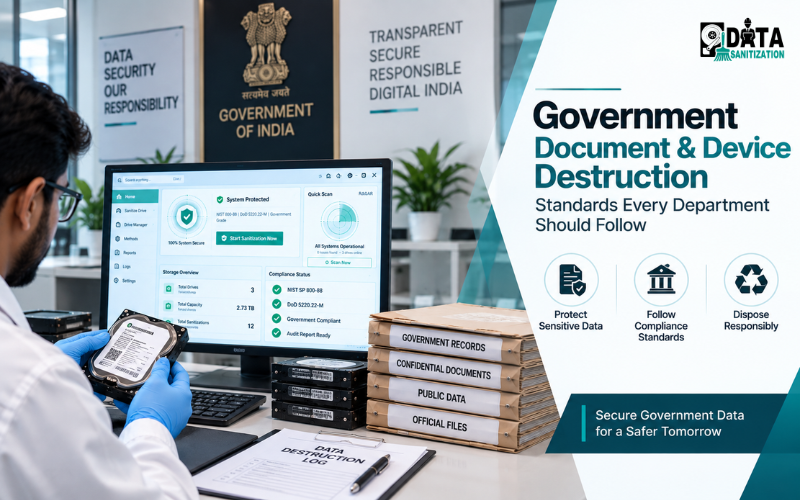
Government departments manage records that may contain citizen information, financial details, tenders, employee records, investigation material, confidential files and operational data. When these records or IT devices reach the end of their retention or service life, simply throwing them away is not a secure disposal process.
A proper government document destruction and device destruction programme should answer three questions:
Was the asset approved for disposal? Was the information securely destroyed? Can the department prove what happened later?
For Indian government departments, this means combining records management, secure document destruction, government IT asset disposal, media sanitization, audit trails and responsible e-waste handling.
What Is Government Document Destruction?
Government document destruction is the controlled disposal of physical records after their applicable retention, review and approval requirements have been completed.
It may include confidential files, printed reports, forms, registers, photocopies and other records that are no longer required.
The Public Records Rules, 1997 state that public records should not be destroyed without recording and review. They also require appraisal of public records older than 25 years, preparation of a list of records proposed for destruction and reporting by the Records Officer. The Rules specify destruction by burning or shredding in the presence of the Records Officer.
This makes secure records destruction a records-management activity, not simply an office-cleaning task.
Why Government IT Device Destruction Is Different
Government records are no longer stored only on paper. Sensitive information can also exist on:
- Laptops and desktops
- HDDs and SSDs
- NVMe drives
- Servers and workstations
- USB drives and memory cards
- NAS and SAN storage
- External hard drives
- Other removable storage devices
Deleting files or formatting a device does not automatically create a defensible media sanitization process.
The correct approach depends on the storage technology, information sensitivity, intended asset disposition and applicable departmental policy.
The current NIST SP 800-88 Rev. 2, published in September 2025, focuses on establishing an organizational media sanitization programme and selecting appropriate methods and controls according to information sensitivity.
For government departments, therefore, data sanitization should be treated as part of the complete IT asset lifecycle.
Key Standards and Rules Government Departments Should Consider
1. Public Records Act and Public Records Rules
The Public Records Act, 1993 gives Records Officers responsibilities related to preservation, review, appraisal, retention schedules and destruction of public records.
The Public Records Rules, 1997 provide procedures for recording, reviewing and weeding out records.
Departments should therefore check the applicable record retention schedule before destroying government documents. Records should not be destroyed simply because they are old or occupy storage space.
2. NIST SP 800-88 Rev. 2
NIST SP 800-88 Rev. 2 is the current NIST guidance for media sanitization. It provides a modern framework for organizations to establish sanitization programmes and select suitable methods based on media and information sensitivity.
It is important to understand that NIST SP 800-88 is not an Indian government law. It is technical guidance that departments may use when required by their security policy, procurement requirements, contracts or organizational standards.
3. E-Waste Management Rules
Old computers, servers, storage devices and other electronic equipment may also fall within India’s e-waste management framework.
The E-Waste (Management) Rules, 2022 came into force on 1 April 2023 and establish requirements for covered electrical and electronic equipment and relevant stakeholders in the e-waste lifecycle.
Therefore, government IT asset disposal should consider both data security and environmentally responsible disposal.
What Should a Government Device Destruction Process Include?
A professional government data destruction process should normally include the following stages:
1. Asset Identification
Record the department, asset ID, device type, make, model, serial number and storage media.
2. Data Classification
Identify whether the device contains public, confidential, personal, sensitive or restricted information.
3. Disposal Authorization
Confirm that the device or record has completed the required retention, operational and approval procedures.
4. Sanitization or Destruction
Select an appropriate method for HDD, SSD, NVMe, USB, memory card or other media.
5. Verification
Verify that the selected sanitization process produced the expected result.
6. Audit Trail
Record the method, device details, operator, dates, verification status and other relevant information.
7. Final Disposition
Record whether the asset was reused, redeployed, transferred, recycled or physically destroyed.
This creates a documented chain from asset identification to final disposition.
HDD, SSD and USB Devices Need Different Treatment
One sanitization method should not automatically be applied to every storage device.
HDDs use magnetic storage. Depending on the security requirement and final disposition, an appropriate sanitization or physical destruction method may be selected.
SSDs and NVMe drives use flash-based storage, so traditional HDD assumptions should not automatically be applied. The sanitization method should be appropriate for the specific technology.
USB drives, SD cards and other flash media also require media-specific handling because information is stored on NAND flash memory.
Departments managing mixed IT assets should therefore identify the storage technology before selecting the data destruction method.
Why Verification and Audit Trails Matter
A government department may need to demonstrate months or years later what happened to retired equipment.
Simply stating that “the hard drive was wiped” is weak evidence without asset-level documentation.
A stronger data destruction audit trail can connect the asset ID or serial number with:
- Sanitization method
- Device information
- Processing date and time
- Responsible operator
- Verification result
- Final disposition
- Certificate or report reference
This documentation can support internal audits, security reviews, asset management and compliance processes.
Data Sanitization Pro for Government Departments
For departments processing large numbers of computers, drives and storage devices, Data Sanitization Pro can help create a controlled and documented data erasure workflow.
Data Sanitization Pro – Government & Defence is a Made-in-India data sanitization platform designed for government, defence and enterprise environments.
It supports offline operation for restricted environments and provides sanitization, verification, reporting and device-assessment capabilities. The platform supports HDD, SSD, NVMe, USB, removable media, RAID, NAS, SAN and other supported storage technologies.
It can also record information related to the sanitization process and generate detailed reports. Offline deployment can be useful for controlled or air-gapped environments where internet connectivity is restricted.
The software should complement—not replace—the department’s records officer, security approvals, retention policies and disposal procedures.
Government Document & Device Destruction Checklist
Before destroying records or retiring IT equipment, departments should confirm:
- Retention period has been completed
- Record has been reviewed and approved
- Required appraisal has been completed
- Sensitive or classified material has received appropriate handling
- Asset ID and serial number are recorded
- Storage technology has been identified
- Appropriate sanitization or destruction method is selected
- Sanitization is verified
- Chain of custody is documented where required
- Certificate or destruction report is retained
- E-waste is transferred through the appropriate channel
- Final asset disposition is recorded
Common Mistakes to Avoid
One common mistake is destroying government documents without checking the applicable retention schedule.
Another is assuming that deleting files or performing a quick format is the same as secure data erasure.
Departments should also avoid using one method for every type of storage. HDD, SSD, NVMe and flash media may require different sanitization approaches.
Finally, outsourcing destruction without defining asset tracking, security controls, reporting and final disposition can create unnecessary accountability gaps.
Government Data Destruction Services in India
Government departments often need more than a basic shredding or wiping service. They need a controlled process that protects information while creating usable evidence.
Data Sanitization’s Enterprise Data Sanitization & ITAD Services cover HDD, SSD, mobile, flash and enterprise storage sanitization. For projects requiring controlled processing at the department’s premises, onsite data wiping and IT asset disposition services can be considered.
For physical hard-drive destruction, HDD destruction services provide destruction and asset-level reporting. For solid-state storage, SSD data sanitization services provide media-specific sanitization options.
Final Takeaway
Government document destruction and IT device destruction should be treated as a governance process—not simply a disposal activity.
For physical records, departments should follow the applicable retention, review, appraisal and destruction procedures.
For digital media, departments should identify the storage technology, select an appropriate sanitization or destruction method, verify the result and maintain an audit trail.
The strongest approach connects records management, cybersecurity, IT asset disposal and e-waste management into one controlled lifecycle.
For government departments in India, the objective is simple:
Destroy only what is authorized. Sanitize data using an appropriate method. Verify the result. Keep evidence.
Related Blogs
Frequently Asked Questions
What are the standards for government document destruction in India?
Government departments should follow the Public Records Act, 1993, Public Records Rules, 1997, applicable retention schedules and departmental procedures. Electronic equipment disposal should also consider applicable e-waste requirements and approved information-security controls.
What is secure government document destruction?
It is the controlled destruction of government records after the required retention, review and authorization procedures have been completed, using an appropriate destruction method and maintaining the required documentation.
What is government IT asset disposal?
Government IT asset disposal is the controlled retirement, reuse, transfer, recycling or destruction of computers, storage devices and other IT equipment after appropriate data sanitization and approvals.
Is NIST 800-88 mandatory for Indian government departments?
No. NIST SP 800-88 Rev. 2 is technical guidance, not an Indian law. A department may adopt it where it is included in its policy, contract, security framework or procurement requirements.
How should government departments destroy old hard drives?
Departments should identify the storage technology and information sensitivity, select an approved sanitization or destruction method, verify the outcome and retain asset-level documentation.
What is the best way to destroy sensitive government records?
The appropriate method depends on whether the record is paper or digital, its sensitivity, retention requirements and final disposition. Paper records may require secure shredding, while digital media requires an appropriate technology-specific sanitization or destruction method.
Why are certificates important in data destruction?
A Certificate of Destruction or detailed sanitization report creates evidence connecting an individual asset with its destruction or sanitization process. This can support audits, internal reviews and asset-disposal records.
Need Onsite Data Sanitization Services?
Do you want Data Sanitization Services to be provided at your location? No worries!! We got it covered. Our team members will be appointed to finish the job at your location after you book the appointment with us. Please feel free to contact us.