Why “Deleting” is the Biggest Risk to Your Enterprise Compliance
In 2026, the gap between deleting data and sanitizing media has become a multi-crore liability. For most IT managers, the “Quick Format” or “Factory Reset” feels like a final step. However, for forensic recovery tools and malicious actors, these are merely minor speed bumps.
The Reality of “Zombie Data”
When you delete a file, the operating system only removes the “pointer” to that data, leaving the actual binary bits intact on the disk. On modern SSDs and NVMe drives, wear-leveling algorithms hide data in “over-provisioned” sectors that standard software cannot reach. This “zombie data” remains recoverable long after the device has left your office, creating a massive “blind spot” in your security posture.
Compliance is No Longer Optional
With the full enforcement of India’s Digital Personal Data Protection (DPDP) Act and global standards like GDPR, the “Right to Erasure” is a strict legal mandate. Failing to provide a verifiable audit trail for retired assets can result in penalties reaching up to ₹250 Crore. Auditors are no longer asking if you wiped your drives; they are asking for the Certificate of Destruction.
The NIST 800-88 Advantage
Moving to a NIST 800-88 “Purge” standard isn’t just about security—it’s about business velocity. By using firmware-level commands and cryptographic erasure, we ensure that:
Data is 100% Irrecoverable: Even under laboratory-grade forensic scrutiny.
Hardware is Reusable: You can safely repurpose or resell assets, supporting your corporate ESG and Sustainability goals.
Liability is Transferred: A serialized Certificate of Destruction serves as your “Get Out of Jail Free” card during a regulatory audit.
Don’t leave your corporate reputation to chance. Ensure every byte is accounted for with professional, certified sanitization.
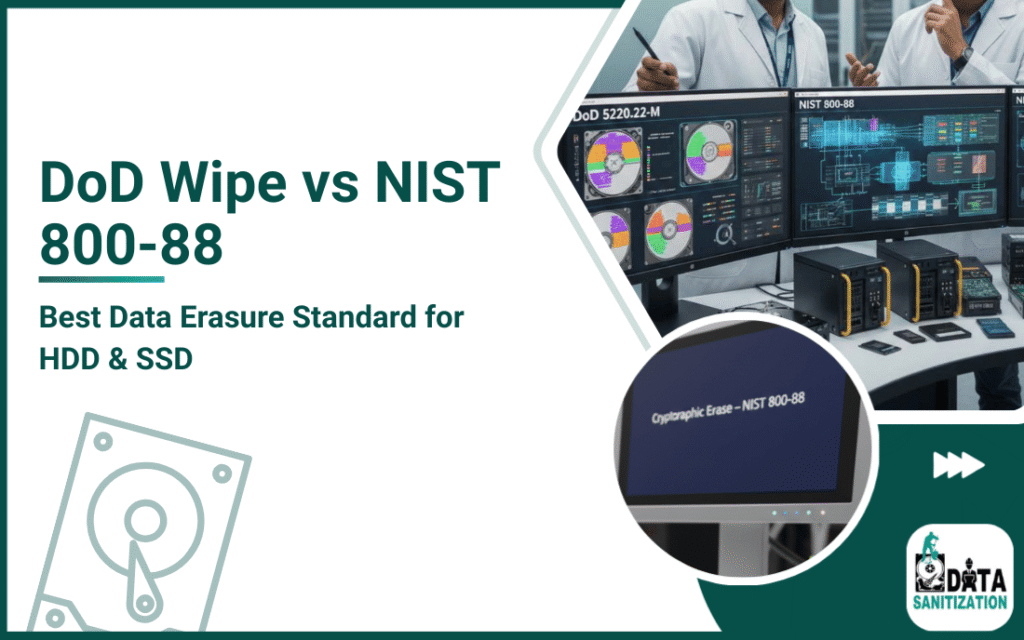
Data erasure is no longer just an IT task. It is a compliance and security requirement. Organizations handling sensitive data must ensure that storage devices are cleaned in a way that data can never be recovered. This is where DoD wipe and NIST 800-88 come into the picture.

Many people search for DoD 5220.22-M, DoD data wipe, Department of Defense hard drive wipe or NIST 800-88 data sanitization, but often feel confused about which standard to use.
This blog explains the difference between DoD wipe and NIST 800-88, how each standard works and which one is best for modern HDDs, SSDs, servers and enterprise storage.
What Is a DoD Wipe?
A DoD wipe refers to data erasure methods based on the DoD 5220.22-M standard originally defined by the U.S. Department of Defense. It became popular as a military-grade data wiping method for hard drives.
DoD wiping works by overwriting data multiple times using specific patterns to ensure that old data cannot be recovered. For many years, it was considered the gold standard for secure hard drive wiping.
How DoD 5220.22-M Wiping Works

The DoD 5220.22-M wiping standard typically uses:
- Multiple overwrite passes
- Fixed and random data patterns
- A final verification step
This approach was designed mainly for magnetic hard disk drives (HDDs). It focuses on ensuring that overwritten data cannot be reconstructed using older forensic methods.
Limitations of DoD Wipe in Modern Environments
While DoD wiping is effective for older HDDs, it has limitations in today’s environment.
Modern storage devices such as SSDs, NVMe drives, USB flash drives and enterprise SAN storage do not behave like traditional hard drives. SSDs use wear-levelling and hidden memory blocks, which means multiple overwrite passes do not guarantee complete data removal.
What Is NIST 800-88?
NIST 800-88 is a modern data sanitization guideline developed by the National Institute of Standards and Technology. It is now considered the global standard for secure data erasure.
NIST 800-88 focuses on risk-based data sanitization rather than fixed overwrite patterns. It applies to HDDs, SSDs, servers, mobile devices, USB drives and enterprise storage.
How NIST 800-88 Data Erasure Works
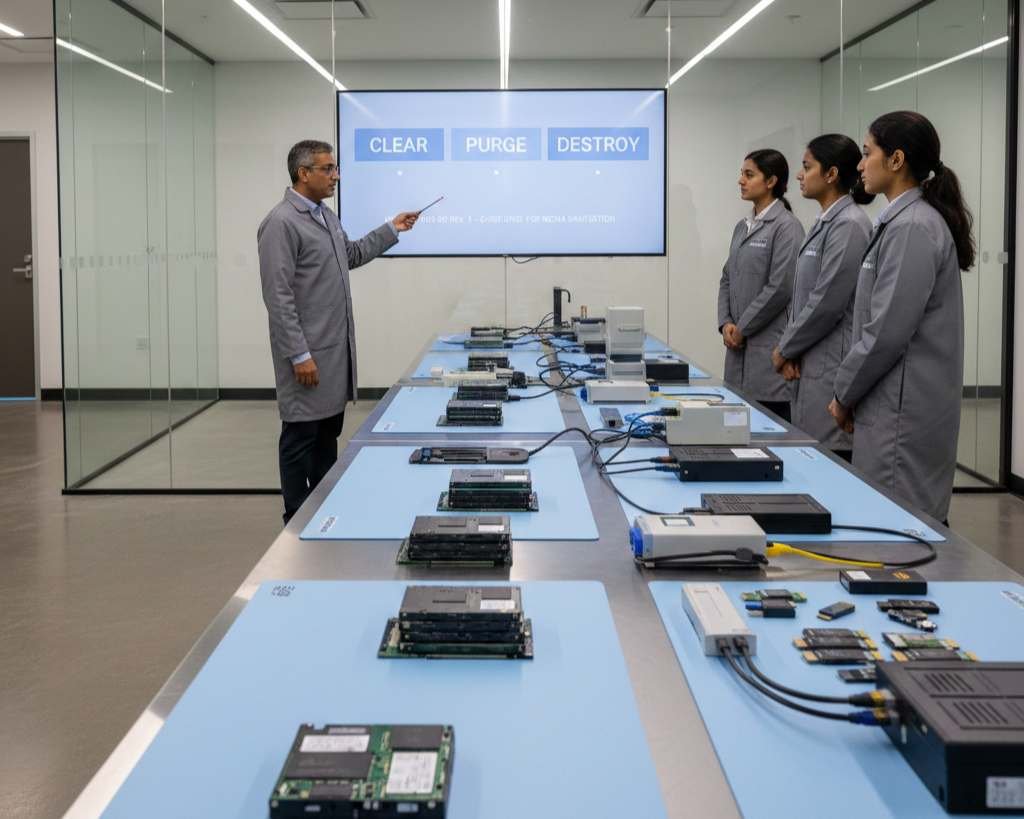
NIST 800-88 defines three clear sanitization methods:
- Clear – Logical overwriting for low-risk reuse
- Purge – Cryptographic erase or advanced sanitization to prevent forensic recovery
- Destroy – Physical destruction when reuse is not required
Instead of relying only on overwriting, NIST 800-88 allows cryptographic erase, firmware-level commands and verification testing, making it far more effective for modern storage devices.
DoD Wipe vs NIST 800-88: Key Differences
| Aspect | DoD 5220.22-M | NIST 800-88 |
| Designed for | HDDs | HDDs, SSDs, USB, SAN, NAS |
| Erasure method | Multi-pass overwrite | Risk-based erase methods |
| SSD support | Limited | Fully supported |
| Verification | Basic | Mandatory verification |
| Compliance focus | Military legacy | Modern global compliance |
| Recommended today | Limited use | Strongly recommended |
Which Standard Is Better for SSDs?
This is one of the most searched questions today.
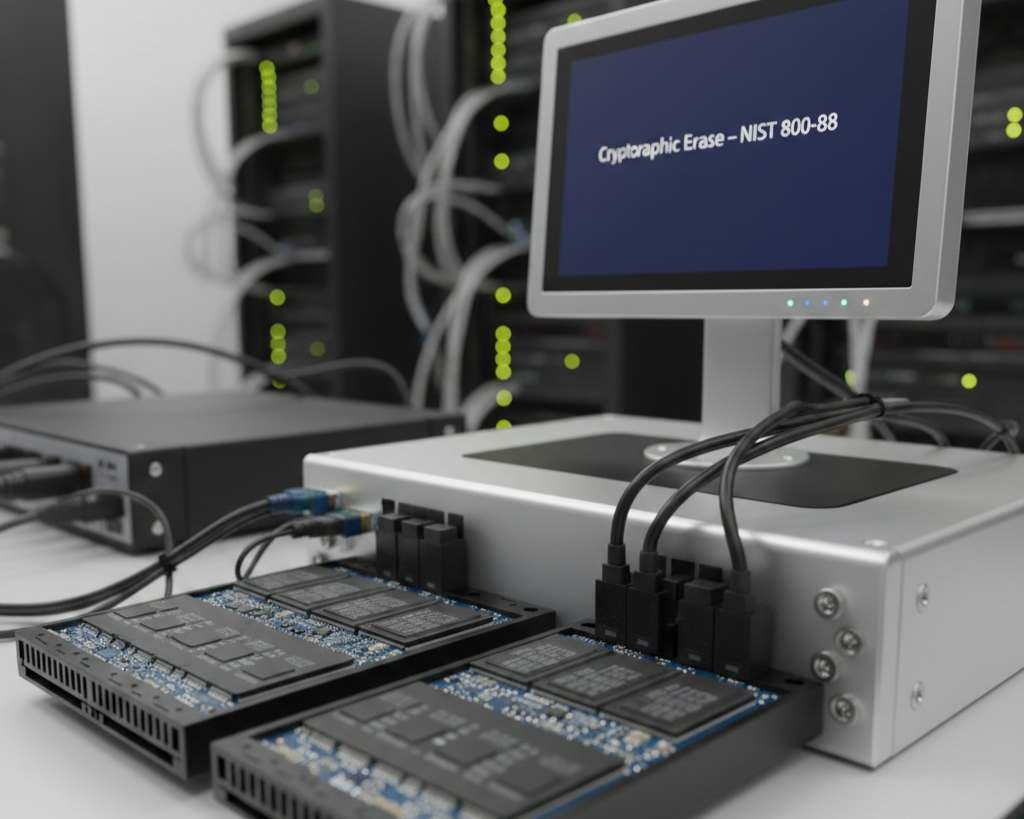
For SSDs:
- DoD wipe SSD methods are not reliable
- Multiple overwrites may miss hidden memory areas
- Data may still be recoverable
NIST 800-88 recommends cryptographic erase or firmware-level secure erase, which is the correct and safest method for SSD data sanitization.
DoD Wipe vs NIST 800-88 for Compliance
Modern regulations and audits focus on:
- Proof of erasure
- Verification reports
- Risk-based methods
NIST 800-88 aligns well with:
- Enterprise compliance
- Government policies
- Data protection frameworks
- Audit and certification requirements
This is why many organizations are moving away from DoD wiping standards and adopting NIST 800-88 compliant data destruction.
When Is DoD Wipe Still Used?
DoD wiping may still be used in:

- Legacy HDD environments
- Specific government contracts
- Situations where overwrite-based erasure is mandated
However, even in such cases, many organizations combine DoD wiping with verification and modern sanitization controls.
Which Data Erasure Standard Should You Use?
For most organizations today:
- NIST 800-88 is the recommended standard
- It supports all modern storage technologies
- It provides stronger compliance and verification
DoD 5220.22-M should be treated as a legacy standard, suitable only for limited HDD use cases.
Why Professional Data Erasure Matters
Whether you use DoD wiping or NIST 800-88, DIY tools and free software are not enough for compliance and security.
Professional data erasure ensures:
- Correct method selection
- Device-specific sanitization
- Verification testing
- Certificates of data destruction
- Audit-ready documentation
Why Choose Data Sanitization for Secure Data Erasure
Data Sanitization provides professional, certified data erasure services following NIST 800-88 and DoD 5220.22-M where required.
With 15+ years of experience and 2800+ global clients, we help organizations securely erase data from:
- HDDs and SSDs
- Servers and data centers
- SAN and NAS storage
- USB and removable media
Our services include verification, detailed reports and certificates while supporting sustainable ITAD practices.
Contact Information
Phone: +91-852-770-9690
Email: support@datasanitization.in
Website: www.datasanitization.in
Final Thoughts
Choosing between DoD wipe vs NIST 800-88 depends on your storage type, risk level and compliance needs.
For modern IT environments, NIST 800-88 is the safer, smarter and future-ready choice.
If data security, compliance and trust matter, certified data erasure is not optional—it is essential.